
Tubing and vacuum
Seven calculators for laying out and running a tubing system.
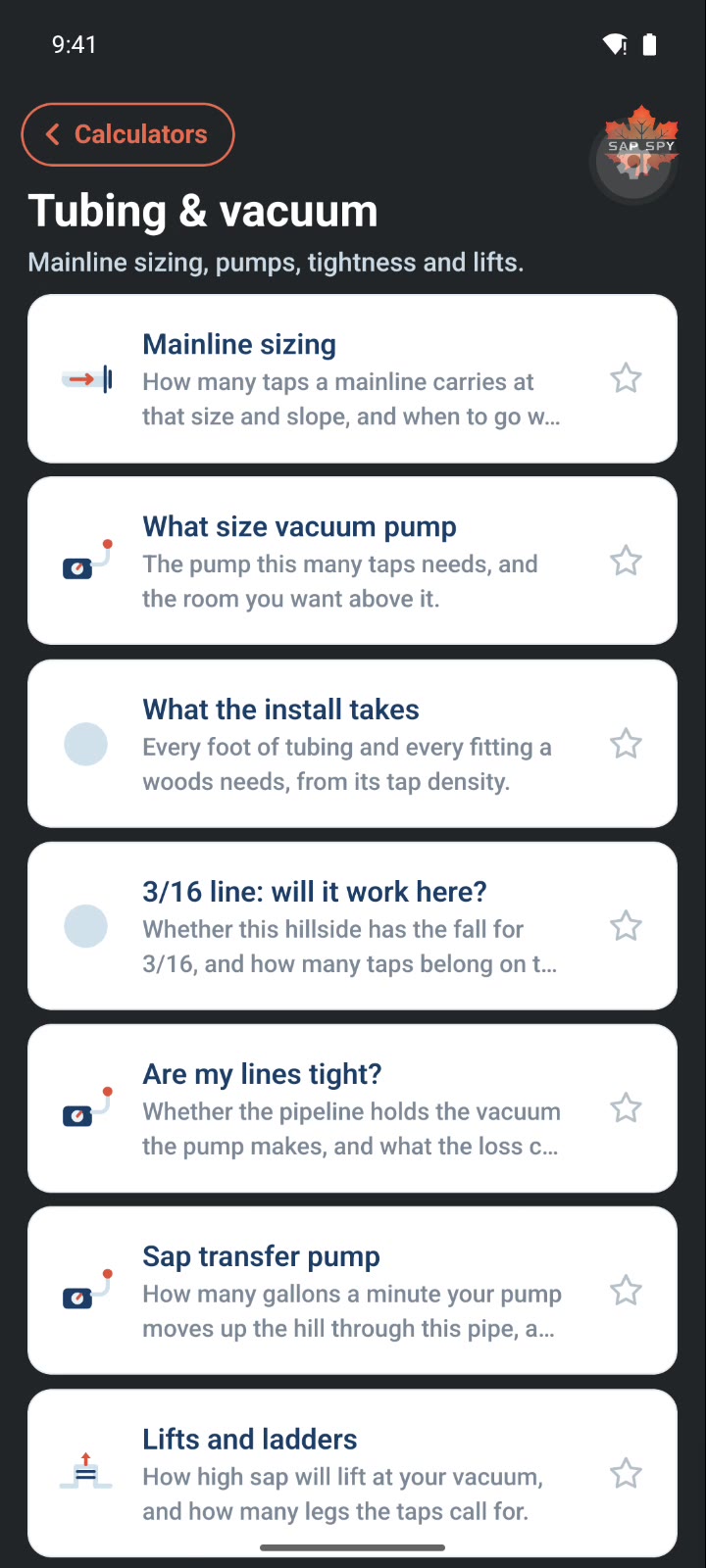
Mainline sizing#
How many taps a mainline carries at that size and slope, and when to go wet/dry. Type the taps on the line and its slope, and pick a diameter.
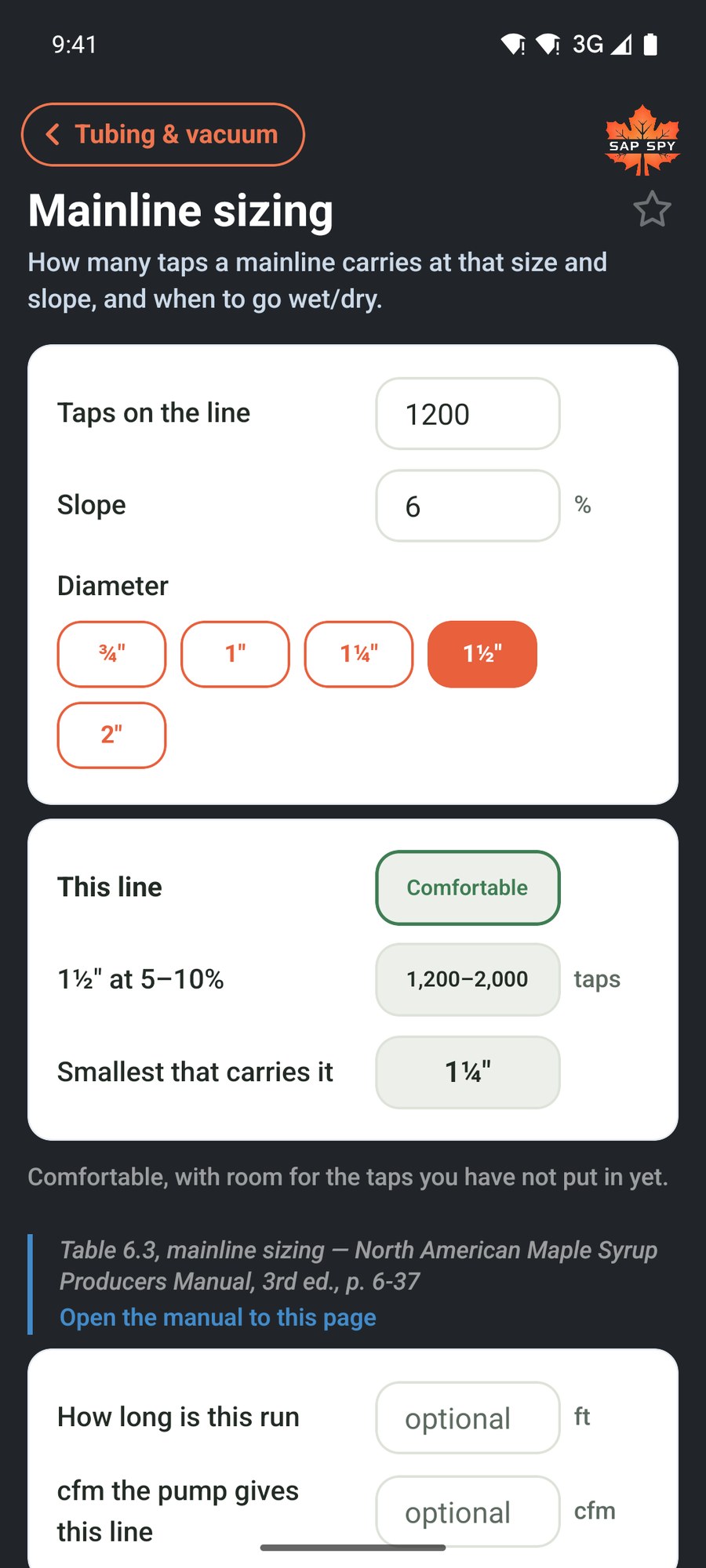
It tells you whether that line is comfortable, the range of taps it carries, and the smallest size that carries yours. The table is the manual's Table 6.3. Add the run's length and the pump's CFM for the Cornell check on friction.
What size vacuum pump#
The pump this many taps needs, and the room you want above it. Type the taps on the system.
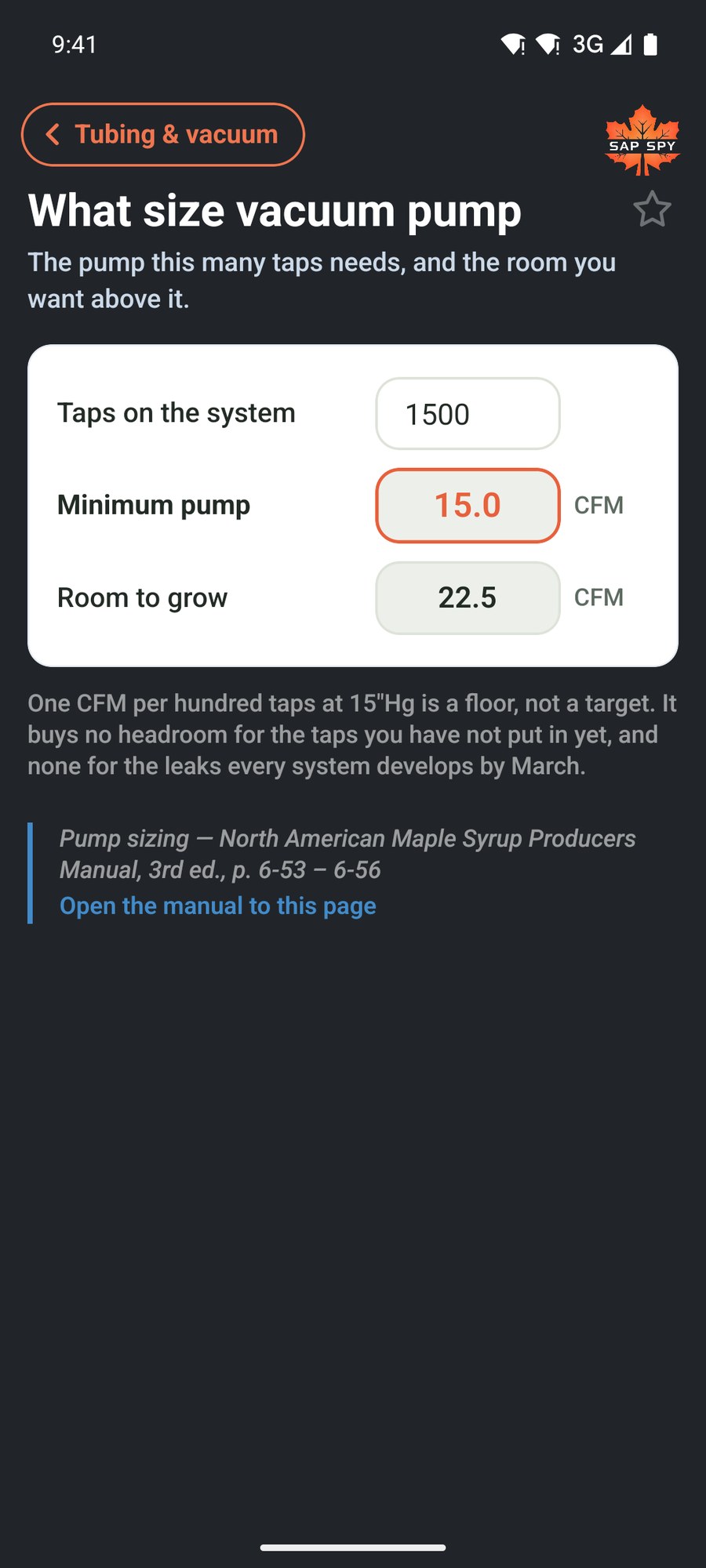
One CFM per hundred taps at 15 inches is a floor, not a target. It buys no headroom for the taps you have not put in yet, and none for the leaks every system develops by March.
What the install takes#
Every foot of tubing and every fitting a woods needs, from its tap density. Type the acres, the taps an acre and the taps on a lateral.
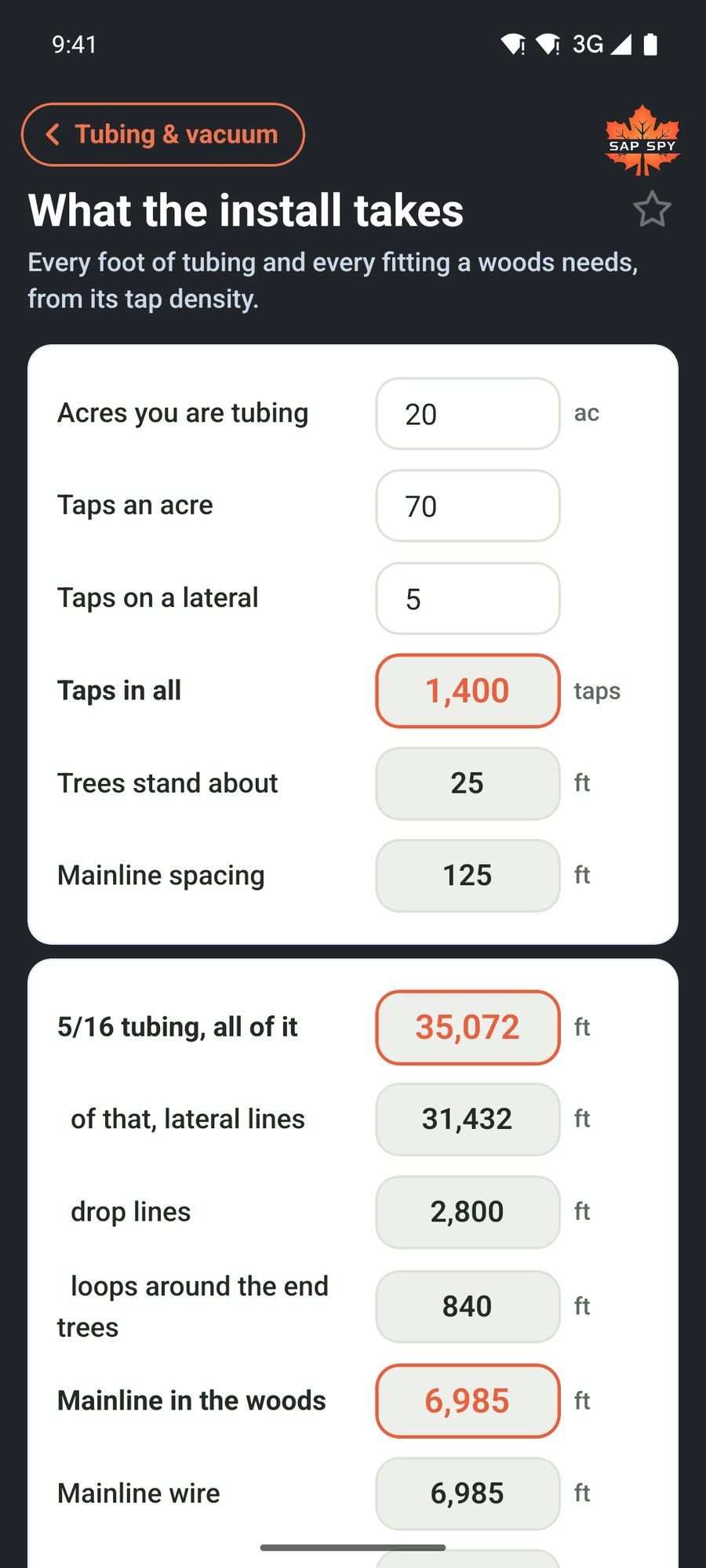
It gives the 5/16 tubing (laterals, drops and loops), the mainline, the mainline wire, the side tie wire, and the spouts, tees and end Ys.
3/16 line: will it work here?#
Whether this hillside has the fall for 3/16, and how many taps belong on the line. Type the fall from the top tap to the bottom of the line, the slope of the run, and the fittings in it.
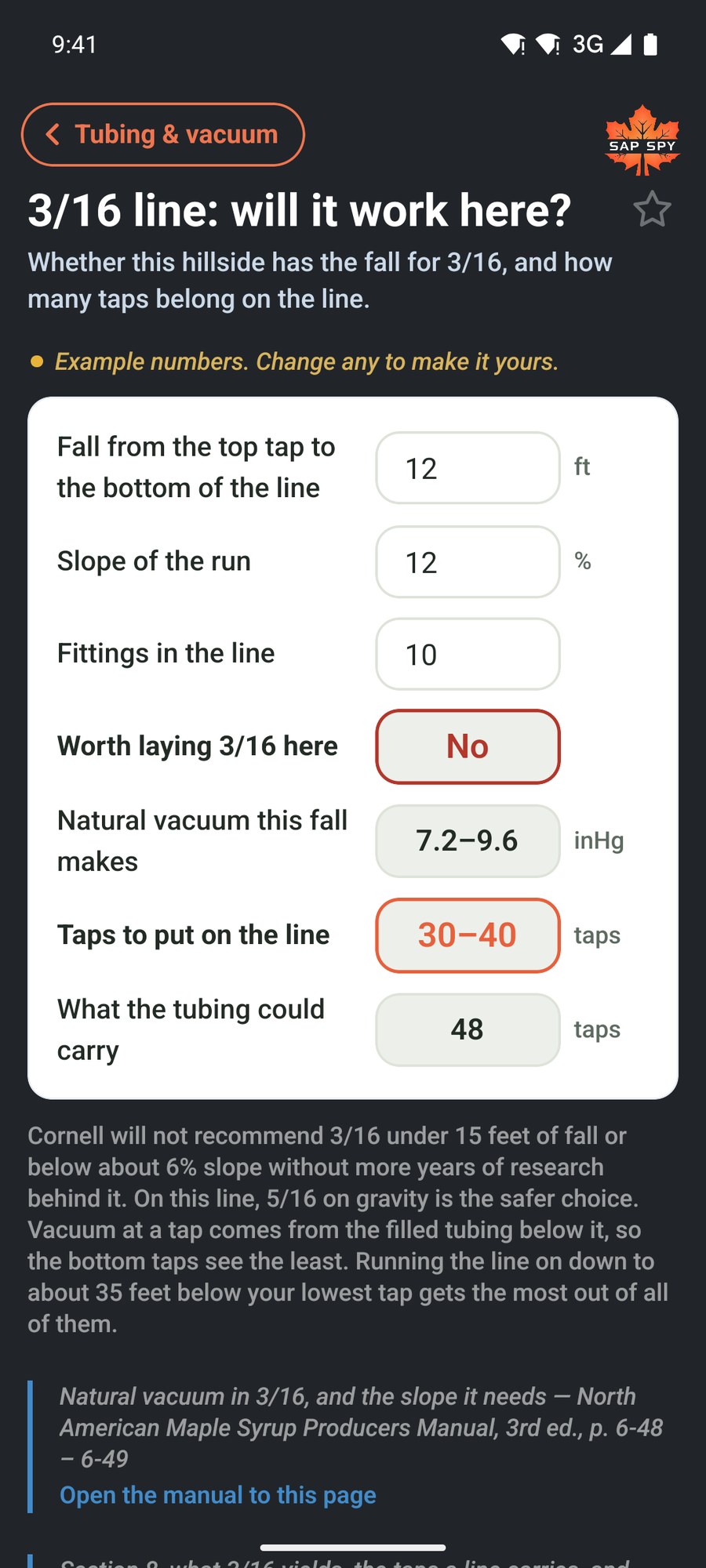
It answers yes or no, gives the natural vacuum that fall makes, the taps to put on the line, and what the tubing could carry. Below that, what one leak does to the vacuum.
Are my lines tight?#
Whether the pipeline holds the vacuum the pump makes, and what the loss costs in yield. Type the vacuum at the pump and at the far end.
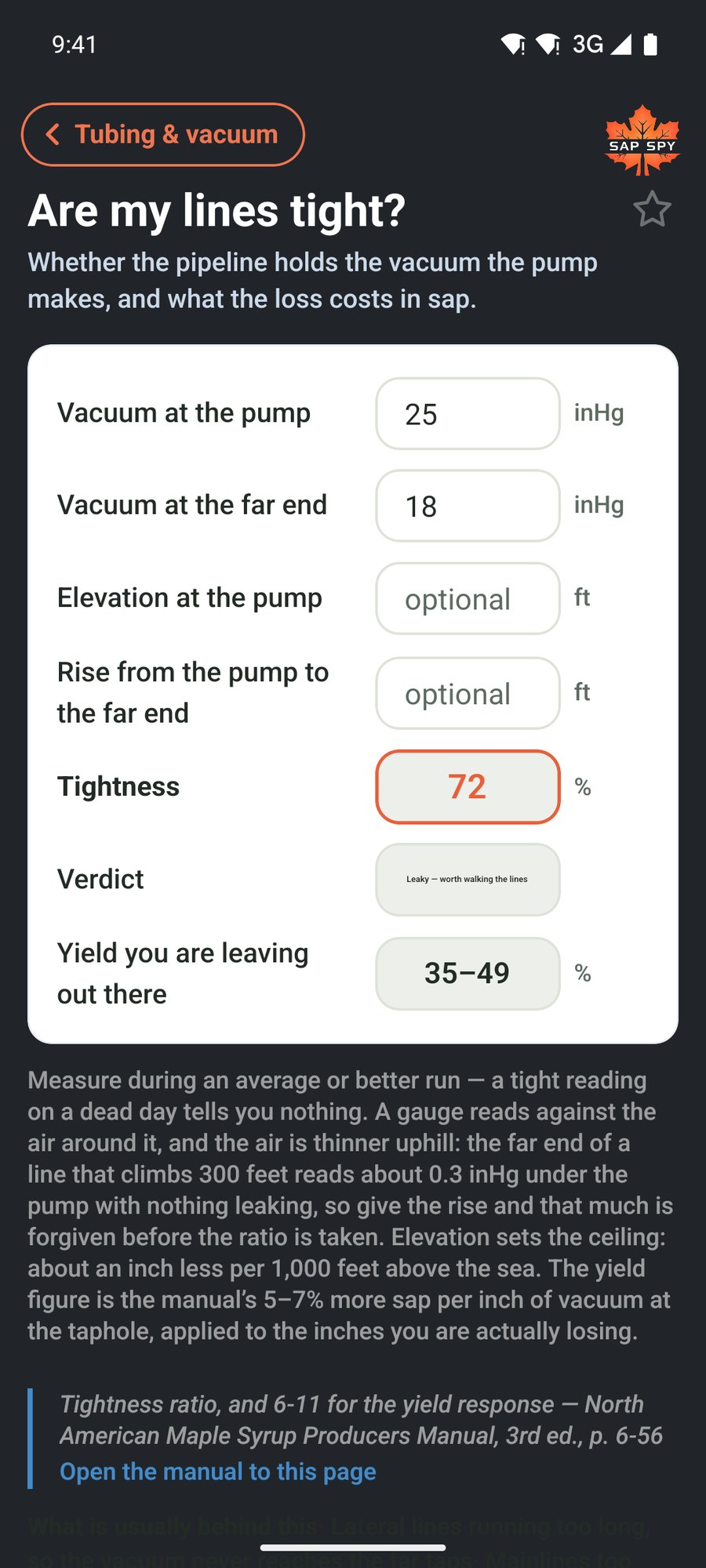
Measure during an average or better run; a tight reading on a dead day tells you nothing. If the far end is uphill of the pump, add the elevations: a gauge reads against the air around it, and the air is thinner uphill.
Sap transfer pump#
Two questions, picked at the top: Check my pump and Size a pump. Either way, the answer comes first in a plain sentence, with a tip worked out from your own line: whether the pipe or the climb is holding you back, and what a bigger pipe would do. The chart and the full table of pipe sizes sit under Show the working. Don't know the rise? Draw the line in Map My Woods, make it a pump line, and tap Calculator on its card: the calculator opens with the line's length and rise filled in.
Check my pump. How many gallons a minute your pump moves up the hill through this pipe, and how long a tank takes. Pick whether the pump draws from a tank or out of an extractor, then the pump, and the pipe it pushes through. Type the length of the line, the rise to the far end, and the sap to move.
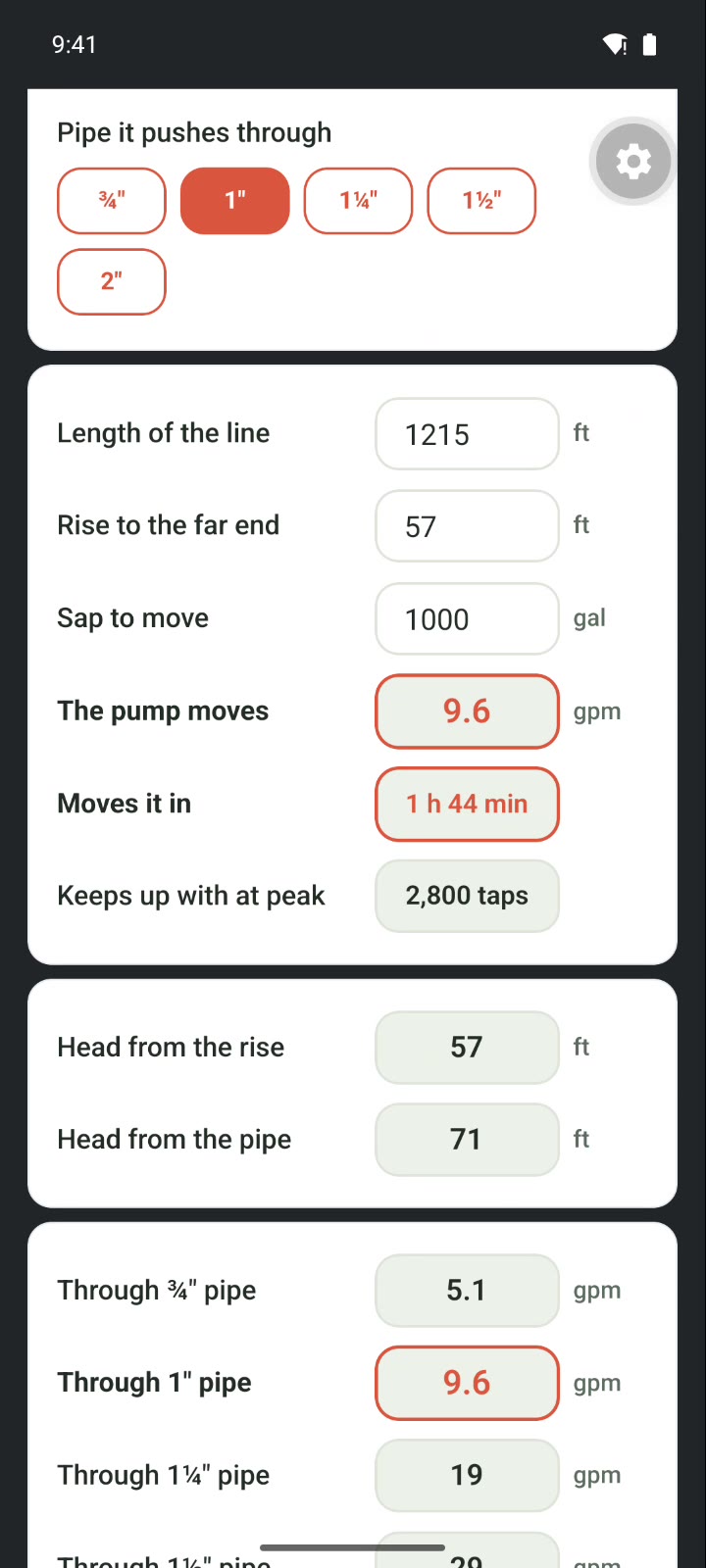
It gives the gallons a minute, how long that sap takes to move, and about how many taps the pump keeps up with at peak flow. Below that, the total head the pump pushes against, in feet and psi, and each part's share of it: the climb, pipe friction, and an extractor's vacuum. A line where pipe friction is most of it wants a bigger pipe more than a bigger pump. Then what the same pump moves through every pipe size, 3/4 inch to 2 inch.
The pumps listed: Honda WX10, WX15, WH15 and WB20; the Pacer 2 inch with a Briggs or a Honda GX160; Goulds GT10, GT15 and GT20; the Pentair Sta-Rite 30DOM and 20DOM submersibles at 1/2, 3/4 and 1 hp, and the Goulds GS 4 inch deep well pumps (10GS at 1/2, 3/4 and 1 hp; 18GS at 3/4, 1 and 1 1/2 hp), in a tank or an extractor (30DOM: 3 stages, more flow, less head; 20DOM: 4 stages, less flow, more head); and, out of an extractor only, the CDL sap lifter. Out of an extractor the list is submersibles only; gas pumps are for a tank.
Out of an extractor, it assumes 28 inches of vacuum, which the pump has to work against as well as the rise.
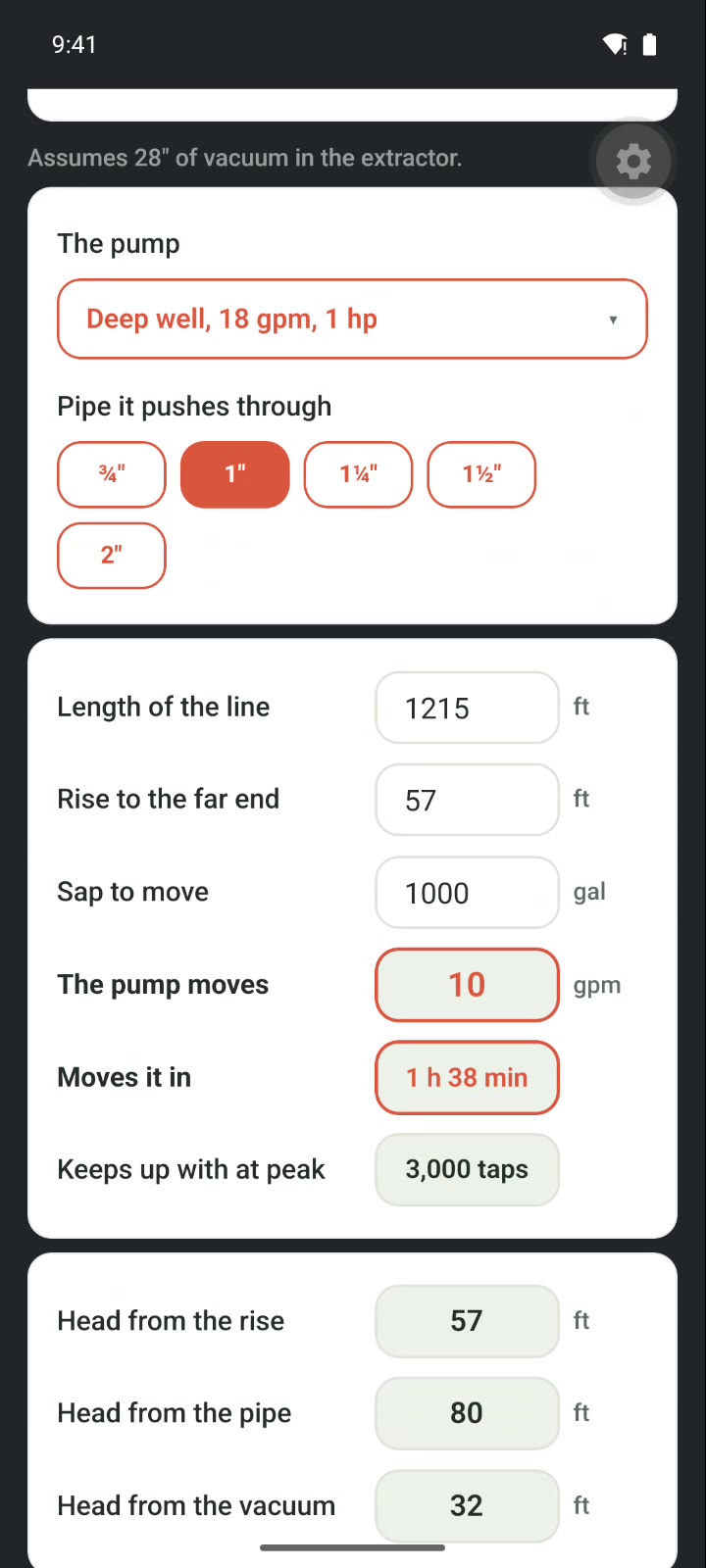
You can run one pump, or two or three of the same side by side: more flow, the same head. Side by side cannot get sap up a line that asks more head than one pump has; that wants a pump with more head, such as the 20DOM over the 30DOM.
Size a pump. Enter the pipe, the length and the rise, and either your taps or the flow you want. It gives what a pump dealer asks for: the flow, the head it has to make at that flow, and the same in psi. Below that, where the head comes from, what each pipe size would need instead, and every pump and setup on the list that reaches it. A chart shows the line's own curve with that point marked: any pump whose curve passes above it will do.
The pump is assumed at ground level, drawing off the bottom of the tank. It counts friction in the pipe only; a run of elbows and valves takes a little more.
Lifts and ladders#
How high sap will lift at your vacuum, and how many legs the taps call for. Type the vacuum at the lift and the taps to lift.
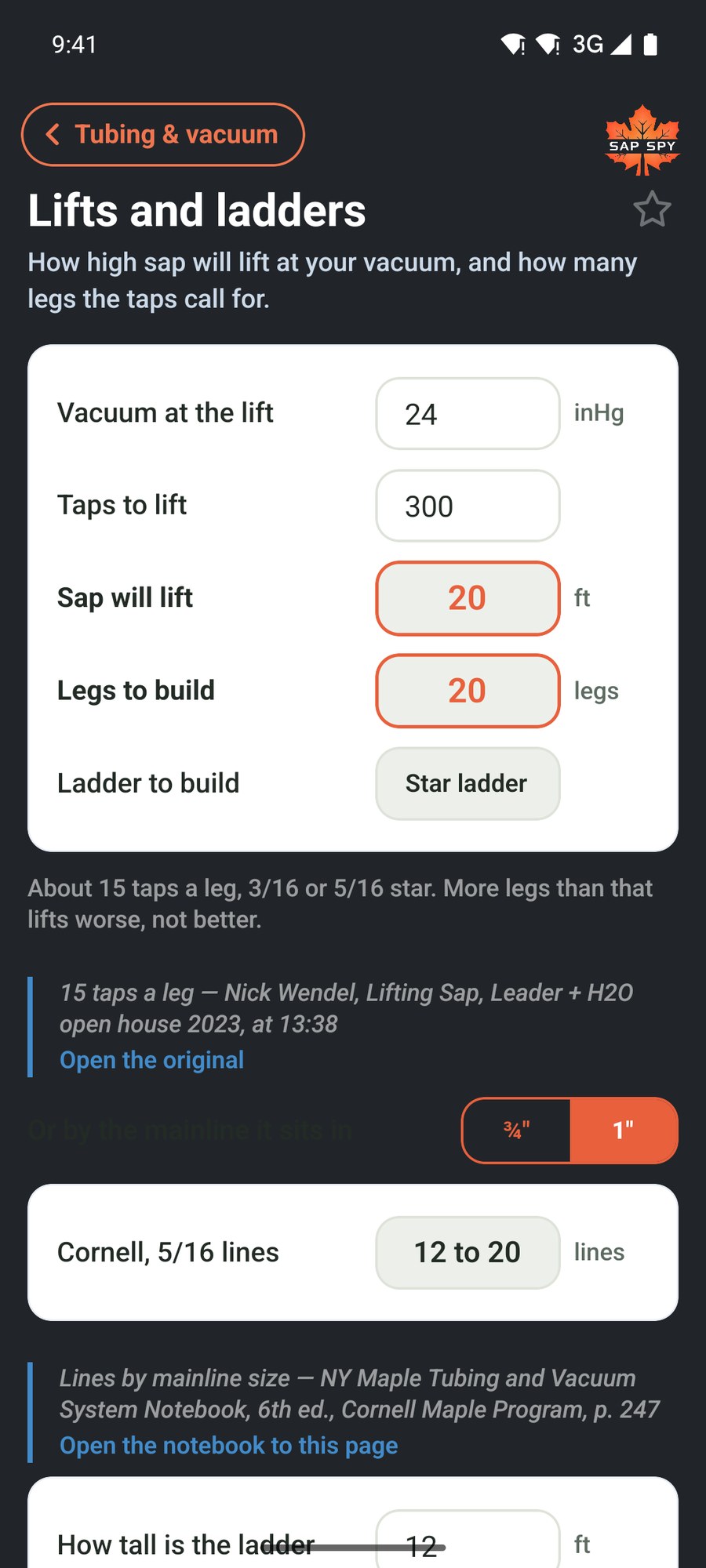
About 15 taps a leg, 3/16 or 5/16 star. More legs than that lifts worse, not better. Below, the Cornell figure for lines by the mainline size the ladder sits in.
FAQs
Comfortable means it has room for the taps you have not put in yet. If you plan to add a lot more, check the line against the taps you will end up with.
A normal, well-kept system reads in the high eighties. Each point of vacuum lost at the far end costs yield; the calculator puts a number on it.
Cornell's design figure for peak sap flow on a vacuum system: 0.2 gallons a tap an hour (the Cornell tubing notebook, page 158). Each gallon a minute the pump moves keeps up with about 300 taps.
The rise and the pipe ask more than the pump can push, and nothing reaches the far end. Try the next pipe size up, or a stronger pump.
Send us its make and model from Feedback in the app, and we will add its curve. Until then, pick the listed pump closest to it in flow and height.
Have a question this doesn't answer? Email info@sapspy.com or call 920-809-4811 — we're producers too.
This website uses cookies that help the website to function. We use these cookies to provide you with improved and customized user-experience. By tapping 'accept,' you consent to the use of cookies. For more info, see our privacy policy.